Types of Loft Conversions: A Complete Guide for UK Homeowners
If you’ve started looking into a loft conversion, chances are you’ve already realised there’s more than one way to do it. And this is where a lot of homeowners get stuck.
Velux, dormer, hip to gable, mansard… it can all start to sound like industry jargon pretty quickly.
But choosing the right type of loft conversion really does matter. Get it right and you’ll end up with a space that feels like it’s always been part of your home.
Get it wrong and you could spend more than you need to, or worse, end up with a room that never quite works.
The truth is, not every loft is suitable for every type of conversion. Roof shape, head height, budget, and even where you live all play a part.
Some options are quicker and less disruptive, others give you far more space but come with higher costs and planning considerations.
In this guide, I’ll walk you through the main types of loft conversions in plain English, what they’re best suited for, and when they make sense.
If you’re still at the early stages, it’s also worth reading our full guide on what a loft conversion actually involves before diving into the details.
Let’s figure out what will genuinely work for your home, not just what looks good on Instagram.
What Determines the Type of Loft Conversion You Can Have?
Before anyone starts talking about dormers or Velux windows, there’s a more important question to answer.
What will your house actually allow?
The first thing we always look at is the roof itself. The shape and pitch make a huge difference.
A steeper roof usually gives you more usable space, while a shallow pitch can limit your options straight away.
Then there’s head height. If you can’t comfortably stand up in the middle of the loft now, that doesn’t mean it’s impossible, but it does mean the conversion will be more involved and more expensive.
Your property type matters too. Terraced houses, semis and detached homes all behave differently when it comes to loft conversions.
A semi with a hipped roof might suit a hip to gable conversion perfectly, while a terrace may be better suited to a dormer.
This isn’t guesswork, it’s about working with the structure you already have.
Planning rules also play a part. Some conversions fall under permitted development, others don’t, and where you live can change what’s allowed.
It’s not something you want to assume and get wrong later.
Finally, be honest about budget and how you’ll use the space.
Is this a spare bedroom, a proper main bedroom with an ensuite, or a home office you’ll use every day?
Your answers shape the right solution. There’s no point forcing a conversion that looks impressive on paper but doesn’t suit how you actually live.
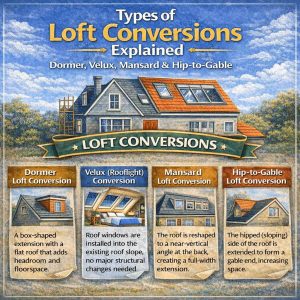
Velux Loft Conversions
A Velux loft conversion is often where these conversations start, and for good reason.
It is the simplest way to turn an unused loft into a usable room without tearing half the roof off your house.
In plain terms, Velux windows are fitted into the existing slope of your roof to bring in natural light.
The roof shape stays exactly as it is. There are no major structural changes, no big extensions, just better use of the space you already have.
If your loft already has decent head height, this option can work extremely well.
We see it regularly with homeowners who want a home office, a guest bedroom, or a quiet space away from the rest of the house.
The real question is simple. Can you already stand up comfortably in your loft?
Best suited for
Velux conversions are best for lofts with good existing head height and a straightforward roof structure.
They suit homeowners who want to keep costs sensible and disruption low. If you are planning to stay living in the house during the build, this type of conversion is often the least stressful option.
Pros
The main advantage is cost. Velux conversions are usually the most affordable type of loft conversion.
In many cases, they fall under permitted development, which means no full planning application is required.
Build times are shorter, and the work is far less disruptive compared to larger conversions.
Cons
The downside is space. A Velux conversion does not create extra headroom or additional floor area.
If your loft feels tight now, it is likely to feel tight after the conversion too. Low roofs or awkward angles can quickly limit what you can achieve, and this is where this option stops being suitable.
My honest view is this. If your loft already works height wise and you want a clean, efficient conversion, Velux is hard to beat.
If gaining space is your main priority, this probably is not the right route for you.
Dormer Loft Conversions
If there is one type of loft conversion we build more than any other, it is the dormer.
There is a reason you see them everywhere across the UK. They work, plain and simple.
A dormer loft conversion involves extending out from the existing roof, usually at the rear of the property, to create additional headroom and floor space.
Instead of squeezing furniture under sloping ceilings, you get proper vertical walls and a room that feels like it genuinely belongs in the house.
This is often the point where homeowners say, “Yes, this actually feels like a real room now.” And they are right.
Best suited for
Dormer conversions are ideal if your current loft feels cramped or awkward.
If you want a proper bedroom, a home office you can comfortably work in all day, or an ensuite without ducking every time you stand up, a dormer is usually the answer.
They suit most property types, especially terraced and semi detached houses, and they are often the best balance between space gained and overall cost.
Pros
The biggest advantage is space. A dormer creates usable floor area and proper head height, which completely changes how the loft feels.
Design wise, there is flexibility too. You can position windows exactly where you want light, views, and ventilation.
They are also incredibly popular with buyers. From a value point of view, a well designed dormer conversion almost always pays its way.
Cons
Dormers cost more than a simple rooflight conversion. There is more structural work involved, and in some cases, planning permission may be required. They are also more visible externally, which can matter in certain areas.
My honest take is this.
If you want your loft to feel like a genuine extension of your home, not just a converted attic, a dormer is very hard to beat.
Hip-to-Gable Loft Conversions
Hip to gable conversions are one of those options people rarely think about at first, but once they understand what it does, it suddenly makes perfect sense.
If your home has a sloping roof on the side, you are probably already wasting more space than you realise.
A hip to gable conversion involves extending that sloping side of the roof upwards to create a full vertical wall.
In simple terms, it squares the loft off. The result is a much bigger, more usable space before you have even thought about adding a dormer.
Best suited for
This type of conversion is ideal for semi detached houses and end of terrace properties where one side of the roof slopes inwards. If your loft feels narrow or lopsided, this is often the missing piece.
It is also a great choice if you want a proper layout upstairs, especially when planning a larger bedroom or an ensuite that actually fits.
Pros
The biggest win is space. You gain width, better ceiling height, and far more flexibility with where walls, stairs, and furniture can go.
Hip to gable conversions are often combined with a rear dormer, which together can completely transform the loft into a full size living area.
Visually, when done properly, it looks like it has always been part of the house.
Cons
This is not suitable for every property, and it involves more structural work than simpler conversions.
Costs are higher, and planning permission is more likely to be required.
That said, if your home is suitable, this conversion can unlock space you did not even know you had.
Mansard Loft Conversions
A mansard loft conversion is the heavyweight option. This is not a tweak or a small upgrade.
It is a full transformation of the roof that turns the loft into what feels like a proper new floor of the house.
If you want maximum space and you want it to feel premium, this is usually where the conversation ends up.
A mansard conversion involves altering the roof structure to create near vertical walls and a flatter roof on top.
In plain terms, it squeezes every usable inch out of the loft. The result is a space that barely feels like a loft at all. Would you even know you were in the roof once it is finished?
Best suited for
Mansard conversions are ideal if space is your number one priority and budget comes second.
They work particularly well on period properties, terraced houses, and homes in urban areas where extending outwards is not an option.
If you are dreaming of a large master bedroom, a proper ensuite, or even multiple rooms upstairs, this is often the only conversion that truly delivers.
Pros
You get the largest possible living space of any loft conversion type.
Ceiling heights are generous, layouts are flexible, and the finished result feels substantial and high end.
When done well, it can completely change the value and feel of the property.
This is the option for people who want to do it once and do it properly.
Cons
It is the most expensive route and planning permission is almost always required. The build takes longer and involves more disruption than other conversions.
That said, if you want the best possible result and your home is suitable, a mansard conversion is hard to beat.
Which Type of Loft Conversion Is Best for Your Home?
This is usually where I slow people down and ask the important questions.
What are you really trying to achieve here?
More space, or better value for money?
Because those two don’t always point to the same solution.
Your budget plays a big part in narrowing things down. Some conversions give you a big visual upgrade without a big price tag, while others are about squeezing every last bit of space out of the roof.
If you’re unsure how much you should be spending, it’s worth taking a proper look at our Loft Conversion Costs guide before you go any further.
It saves a lot of guesswork.
Planning restrictions also shape what’s realistic. Some homes have plenty of flexibility, others need a more careful approach.
And then there’s how you plan to use the room. A quiet office needs something very different to a main bedroom with an en suite.
There isn’t a one size fits all answer. The best loft conversion is the one that fits your home, your budget, and your long term plans, not just what looks good on paper.
Planning Permission and Regulations
This is the bit most homeowners worry about, usually more than they need to.
In reality, many Velux conversions and a good number of dormers fall under permitted development, which means no full planning application.
That said, once you start changing the shape of the roof, things tighten up. Mansards and some hip to gable conversions almost always need planning permission, especially in built up areas.
What never changes is building regulations. Every loft conversion must meet them, no exceptions.
Structure, fire safety, insulation, stairs. All of it matters. If someone tells you otherwise, walk away.
Final Thoughts: Choosing the Right Loft Conversion Type
There’s no perfect loft conversion that suits every home, and anyone who says there is probably hasn’t spent much time on site.
What works brilliantly in one house can be a headache in another. Roof shape, budget, planning rules and how you actually want to use the space all matter more than people realise.
The best place to start is with a proper look at your loft by someone who does this day in, day out.
No guesswork, no generic advice, just honest guidance based on your home.
If you want to talk it through, contact Roof To Room and we’ll help you figure out what actually makes sense for your property.