Do you need planning permission for a loft conversion?
This is one of those questions that nearly everyone asks, but usually at the wrong time.
Not at the start, when it is easy to check. Not before money is committed. It normally comes up when drawings are done, builders are booked, and someone suddenly says, “Hang on… do we actually need permission for this?”
Sound familiar?
The truth is, planning rules around loft conversions are not complicated, but they are misunderstood. People hear phrases like permitted development and assume it means they can do whatever they like.
Others think every single conversion needs full planning, which is just not true either. Both of those assumptions cause problems, delays, and sometimes very expensive mistakes.
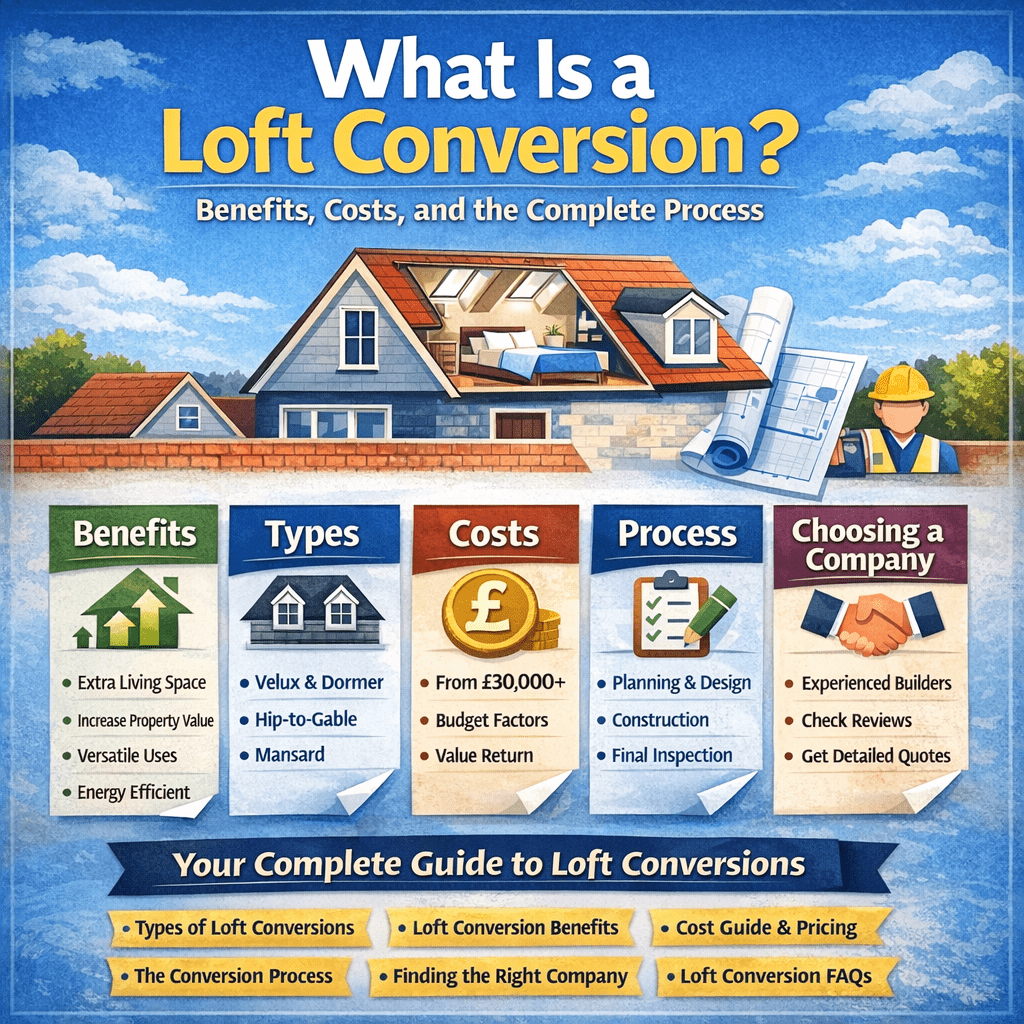
If you are still at the early stage and trying to understand what a loft conversion actually involves, it is worth reading our guide on what is a loft conversion first, because the type of conversion you choose directly affects whether planning permission is needed.
This guide is here to give you straight answers, not waffle. I will tell you when you probably do not need planning, when you almost certainly do, and what tends to trip people up.
No scare tactics, no sales talk, just what actually matters so you can make decisions with confidence.
What planning permission actually means for homeowners
Planning permission is one of those phrases everyone’s heard, but very few people actually understand. In simple terms, it is your local council’s way of controlling how buildings change from the outside.
It is not about how strong your floor is or how safe your stairs are. It is about how your home looks, how it affects neighbours, and how it fits into the wider area. Streets, skylines, light, privacy, character. That is what planning exists to protect.
Where people trip up is confusing planning permission with building regulations. They are completely different things, and I will be blunt here, if your builder treats them as the same, walk away.
Planning permission asks can you do this. Building regulations ask how must this be built safely.
You can be allowed to build something but still fail building control if it is unsafe. And yes, every loft conversion must comply with building regulations, whether or not it needs planning permission. No exceptions.
Planning is enforced by your local authority. They are not out to ruin your day, but they do have powers, including forcing you to undo work if it breaks the rules.
I have seen people have to rip out dormers after spending tens of thousands because they trusted someone who said it would be fine. That is not bad luck. That is bad advice.
There are a few myths I hear constantly. One is that if your neighbour did it, you automatically can too. Not true.
Another is that if it is inside your roof, no one cares. Also not true. And my personal favourite is that you can just sort it out later. You cannot. Retrospective planning is a gamble, not a plan.
So here is the real question. Do you want certainty before you build, or stress after it is finished.
Because that is what planning permission really comes down to. Certainty versus risk.
What is permitted development for loft conversions?
Permitted development is basically a set of national planning rules that let homeowners make certain changes without having to submit a full planning application.
Loft conversions often fall under these rights because, in most cases, you are altering the space inside your roof rather than changing the overall footprint of the house.
That said, this is where people get sloppy. Just because something can be permitted development does not mean it automatically is.
Volume limits apply, appearance rules apply, and how the new space affects neighbours absolutely matters.
I have lost count of how many times someone has said to me, my mate said I do not need permission, only for us to discover they definitely do.
Permitted development lets you move faster and cheaper, but it is not a free pass. Would you rather assume and hope for the best, or check properly and sleep at night? I know which one I would choose.
When does a loft conversion need planning permission?
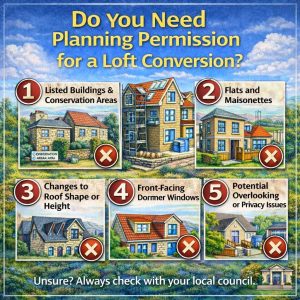
A loft conversion usually needs planning permission when it starts to change the outside of your home in ways that affect the street, your neighbours, or the character of the area.
That is the line councils care about, and it is where most people come unstuck.
If you are altering the roof shape rather than just working within it, that is a red flag. Raising the ridge, changing the pitch, or building out in a way that makes the roof look completely different will almost always trigger a planning review.
The same goes for going beyond the permitted volume limits. Once you exceed those, you are no longer playing by the simpler rules.
Front facing dormers are another common issue. Councils tend to be far stricter about anything visible from the road.
Overlooking problems matter too. If your new windows create privacy issues for neighbours, expect scrutiny.
Listed buildings and properties in conservation areas are in a different league altogether. Flats and maisonettes do not benefit from permitted development rights at all.
This is why guessing is risky. Would you rather find out early, or halfway through a build when someone complains and enforcement gets involved?
Volume limits and size rules explained simply
One of the biggest causes of confusion with loft conversions is the volume allowance. People hear a number, assume it is generous, then design something that quietly goes over it without realising.
For most terraced houses the limit is forty cubic metres. For semi detached and detached homes it is fifty cubic metres. That is the total additional roof space you are allowed to add under permitted development.
Here is the bit people miss. Volume is not measured like floor area. It is measured as a three dimensional block of space.
Height, width and depth all count. A tall dormer eats into your allowance much faster than most homeowners expect.
I have lost count of how many times someone has told me their design is fine because it looks small, only for it to be well over the limit once it is properly calculated.
Do you want to design something twice, or get it right the first time?
This is why guessing based on sketches or online examples is a bad idea.
A proper assessment early on saves stress, redesigns, and awkward conversations with planners later.
Height, roofline and external appearance rules
This is where a lot of people trip up, because they focus on what they want inside and forget the outside still matters.
Under permitted development, you cannot build anything higher than the highest point of your existing roof.
No sneaky extra lift. No clever angles to squeeze more headroom. If it sticks up above the ridge, you are straight into planning territory.
Materials also matter more than people expect. Councils want new dormers and extensions to blend in with the existing house.
That usually means similar brick, tile colour, render or cladding. The goal is not to make your home invisible, but to stop streets turning into a patchwork of mismatched add ons.
Why do councils care so much about this?
Because planning is about the wider area, not just your house. Visual impact affects neighbours, street character and sometimes even property values.
And here is my honest take. If your loft looks like it has been bolted on as an afterthought, you will regret it every time you pull up outside. Good design should look like it was always meant to be there.
Would you rather save a few quid on materials now or have something that looks right for the next twenty years?
This is one of those areas where cutting corners always shows.
Conservation areas, national parks and special zones
If your home sits in a conservation area, the rules change, and not by a little.
A conservation area is a place the council has decided has special architectural or historic value.
That could be Victorian terraces, old market towns, seaside streets, or anything with a strong visual identity. The whole point is to protect how the area looks and feels. That means even small external changes can trigger planning.
Then there are Article 4 directions. These remove your permitted development rights entirely. No shortcuts. No assumptions.
If you are in one of these zones, almost any external alteration needs approval. I see people get caught out by this all the time because they never check.
The same goes for Areas of Outstanding Natural Beauty and national parks. These are protected landscapes. Councils are far stricter about what you can change, how it looks, and how visible it is from public land.
Here is my honest advice. Never guess. Never assume. If your house is in one of these zones, you must check before you design anything.
Would you rather spend ten minutes confirming your status now or months untangling a refusal later?
This is one of those moments where caution saves serious money.
Do Velux and rooflight loft conversions need planning permission?
In most cases, no. Standard rooflights and Velux style windows usually fall under permitted development because they sit flush with the roof and do not change the shape of the building.
From the street, they barely register. That is exactly why councils tend to allow them.
But and this is where people trip up they are not always exempt.
If the rooflight faces the front of the house and alters the look of the property, some councils will want to review it.
If you are in a conservation area, national park, or an Article 4 zone, the rules tighten fast. What would be fine on one street can be refused on the next.
Here is my blunt view. Rooflights are the safest option planning wise, but only if you check properly.
Would you rather assume and risk enforcement, or confirm and sleep easy?
I know which one I choose every time.
Do dormer loft conversions need planning permission?
Often, no. A lot of dormer loft conversions fall under permitted development, especially when they are built at the rear of the property and keep within the volume limits.
That is why you will see so many rear dormers going up without a formal planning application.
But this is not a free for all.
As soon as a dormer starts changing how the house looks from the street, things get more complicated.
Front facing dormers almost always trigger planning. Side dormers can be hit and miss depending on visibility. Oversized boxy dormers that dominate the roofline are another red flag.
Here is my honest take. Councils care about visual impact more than people realise. If it looks like you have bolted a shipping container onto your roof, expect questions.
Rear dormers are usually the safest bet. Side dormers sometimes pass. Front dormers nearly always need permission.
So ask yourself this. Is your dormer designed to blend in, or to stand out?
That answer usually tells you whether planning will be needed before anyone even opens a rulebook.
Do Hip to gable and mansard conversions need planning permission?
Hip to gable and mansard conversions change the actual shape of your roof. Not the inside. The outside. That is why they are far more likely to need planning permission.
A hip to gable removes the sloping side of the roof and replaces it with a full vertical wall.
A mansard changes the entire rear roof slope into a near vertical face with a flat top. Both massively increase usable space. Both also dramatically alter how the property looks.
And that is the key point. Councils are not just interested in what happens inside your house. They care about how it affects the street, the skyline and the character of the area.
From a planning perspective these are not subtle changes. They are visible. They change proportions. They can affect neighbours light and outlook. That is why they get scrutinised more closely.
In my experience, people assume these will slide through because they have seen them elsewhere. But what worked on one street does not automatically work on another.
So here is the real question. Are you trying to quietly gain space or make a bold architectural statement?
If it is the second one, planning permission is almost always part of the process.
What about terraced, semi detached and detached homes?
The type of house you own makes a bigger difference to planning rules than most people realise.
Detached homes usually have the most freedom. More roof faces, more distance from neighbours, fewer shared boundaries.
That often means fewer objections and more scope under permitted development. But that does not mean anything goes. Visual impact still matters.
Semi detached houses sit in the middle. You share a wall, you share a roof line, and any change you make affects someone else’s view of the world.
Councils look closely at balance here. If one side suddenly looks heavier or taller, it can trigger a planning review.
Terraced homes are the most sensitive. You are part of a continuous row, so any external change stands out.
Rear dormers can still fall under permitted development, but side changes and anything visible from the street almost always attract attention.
Then there are party walls. These are not planning issues, but they matter. Shared walls mean shared impact.
Noise, vibration, structural changes. Ignore this and you end up in disputes that slow everything down.
Here is my honest view. If your conversion will change how your house looks from outside and how it relates to its neighbours, you should assume planning will be involved.
Would you rather know early or find out halfway through the build?
That choice alone can save months of stress.
Does a loft conversion need neighbour permission?
Short answer, no, you do not need your neighbour’s permission to build a loft conversion. But that does not mean neighbours are irrelevant.
This is where people get confused. Neighbours do not get a vote on your plans. They cannot block a compliant loft conversion just because they do not like it. Planning decisions are made by the council, not by the person next door.
However, neighbours can raise objections during a planning application, and those objections can matter if they relate to real planning concerns.
Things like overlooking, loss of privacy, blocking light, or the visual impact on the street scene. Councils have to consider these points. They cannot ignore them.
What neighbours cannot do is object based on inconvenience. Noise during the build, scaffolding, vans outside, or personal dislike are not valid planning reasons. Annoying, yes. Grounds for refusal, no.
Then there is the Party Wall side of things. This is completely separate from planning. If you share a wall or are working close to a boundary, you may legally need a Party Wall Agreement.
This is about protecting both properties during construction, not about stopping the project. It is a legal process, not a popularity contest.
Here is my firm view. Talk to your neighbours early, even if you do not legally have to. Not because they control your project, but because a calm conversation saves a lot of grief.
Would you rather deal with a friendly chat now or a formal letter later?
Most disputes I see are not about planning at all. They are about poor communication.
Get that right, and everything else becomes easier.
What happens if you build without permission?
Building a loft without the right permissions is one of those shortcuts that nearly always comes back to bite.
Councils can issue enforcement notices that force you to change or even remove what you have built. I have seen perfectly good lofts partially ripped out because someone assumed it would be fine.
Some people try to fix it later with retrospective planning. Sometimes it works. Sometimes it does not. And when it does, it usually costs more, takes longer, and causes far more stress than doing it properly in the first place.
Then there is the selling problem. Solicitors ask for paperwork. Buyers ask for certificates. Mortgage lenders get nervous.
If you cannot prove your loft was done correctly, deals fall through or prices get knocked down. I have watched homeowners lose tens of thousands because a missing approval scared buyers away.
So ask yourself this. Is skipping checks really worth the risk?
My honest view is this. If a builder ever tells you planning does not matter, walk away. Good projects are built on solid paperwork, not crossed fingers.
How to check if your loft needs planning permission
The safest way to check is through your local council portal. Every council has an online planning map and guidance pages, and while they are not always written in plain English, they do show what has been approved nearby and what rules apply in your area. That context matters more than people realise.
A better option is applying for a Lawful Development Certificate. This is a formal piece of paper from the council that confirms your loft falls under permitted development.
It is not glamorous, but it is gold dust when you sell your home. Solicitors love it. Buyers trust it. Mortgage lenders ask for it.
Architects and planning consultants can also check this properly. They look at roof volume, setbacks, window positions and conservation overlays. That is not guesswork. It is measured.
What I would never rely on is verbal advice. Someone at the council saying it should be fine means nothing legally. Neither does a builder saying they have done loads like this before.
My view is simple. If you are spending tens of thousands on a loft, get certainty in writing. Why gamble on something that can be confirmed properly before a single tool turns up?
What is a Lawful Development Certificate and do you need one?
A Lawful Development Certificate is basically written proof from the council that your loft conversion is allowed under permitted development and does not need planning permission.
It does not give you permission. It confirms that you already have it. That difference matters more than people realise.
Why does it protect you?
Because rules get interpreted differently over time. Planning officers change. Councils update guidance. Neighbours complain. Without that certificate, you are relying on memory and emails that carry no legal weight.
With it, you have a formal decision on record that says your build is lawful. No arguments. No grey areas.
Buyers and solicitors love these things. When you sell, one of the first questions is often whether the loft had planning permission or fell under permitted development.
If you cannot prove it, deals slow down, surveys flag risks, and mortgage lenders start asking awkward questions.
Here is my honest take. If your loft is under permitted development, you should still get one. It costs a fraction of the build price and removes a massive amount of future stress.
Would you really want to explain planning rules to a nervous buyer years from now, or would you rather just hand over a certificate and move on?
How long does planning permission take?
In simple terms, most loft conversion planning applications take between eight and twelve weeks from submission to decision.
Sometimes quicker. Sometimes much slower. And that gap is where people get frustrated.
First comes validation. This is the council checking that your application is complete. If anything is missing, wrong, or unclear, it gets bounced back.
I have seen this stage alone drag on for weeks when drawings are vague or forms are rushed. This is why I always say preparation matters more than people think.
Then there is the consultation period. Neighbours are notified. Internal departments get involved.
Conservation officers might weigh in. This usually runs for about three weeks. Most objections do not kill an application, but they can slow it down.
After that, the planning officer makes a recommendation and a decision is issued. Officially, councils aim for eight weeks on standard householder applications. In reality, workloads, holidays, and backlogs often stretch that.
And if it is refused, appeals can take months. Sometimes longer.
Here is my honest opinion. If your project needs planning permission, build the timeline into your expectations from day one. Rushing it only leads to stress and mistakes.
Would you rather wait a few extra weeks and get it right, or gamble and pay for it later in redesigns and delays?
How much does planning permission cost?
The actual council fee for a standard householder planning application in England is currently just over two hundred pounds. That number lulls people into thinking planning is cheap. It is not.
The real cost usually sits around the application, not the form itself. Proper drawings from an architect or technician can run into the hundreds or even low thousands, depending on complexity.
If your property is in a sensitive area, you might also need surveys such as heritage statements, daylight assessments, or tree reports. Those are not optional once a council asks for them.
Then there is consultant time. Planning consultants, designers, and sometimes structural input all add up.
None of this is wasted money. It is what makes an application clear, defensible, and far more likely to be approved.
This is where cheap quotes catch people out. If a builder says planning is only a couple of hundred quid, ask what they are not including. Because something is missing. Always.
My view is simple. If you need planning permission, budget properly for it.
Would you rather spend a little more upfront and get a smooth approval, or gamble on a cut price approach that comes back to bite you?
Planning is not just a form. It is a process.
Planning permission vs building regulations
This is one of the biggest sources of confusion I see, and it causes more unnecessary stress than almost anything else.
Planning permission is about what you are allowed to build. It looks at the outside impact. How it changes the street. Whether it affects neighbours. How it sits in the area. It is about appearance, size, and location.
Building regulations are about how it is built. Structure, fire safety, insulation, stairs, headroom, soundproofing, ventilation. In other words, whether the space is actually safe and legal to live in.
You can have a loft that does not need planning permission but still absolutely must meet building regulations. This is where people trip up. They hear no planning needed and assume no rules apply. That is wrong.
Councils care about planning because it protects the wider area. Building control cares about regulations because it protects you and anyone who lives there.
If I had a pound for every time someone mixed these up, I would not need to build lofts anymore.
Here is my blunt take. Planning decides if you can. Building regs decide if you should.
Ignore either and you are asking for trouble.
Common planning mistakes homeowners make
Most planning problems I see are not caused by bad intentions. They come from assumptions.
The biggest one is assuming permitted development applies without checking. Just because your mate did his loft last year does not mean yours qualifies. Different streets, different councils, different rules.
Then there is trusting a builder who says it will be fine without showing you anything in writing. Good builders build.
They are not planning officers. If someone cannot explain why your project falls under permitted development, that is a red flag.
Ignoring conservation status is another classic. People buy a lovely character home and forget that charm comes with extra rules.
And finally, not getting certificates. No Lawful Development Certificate. No paper trail. Then panic sets in when it is time to sell.
Let me ask you this. Would you rather spend a bit of time checking now or months fixing it later?
I know which one costs less.
Can planning rules change in the future?
Yes, they absolutely can, and they do more often than people realise.
National policy gets updated, councils revise their local plans, and permitted development rules get tweaked.
What was allowed five years ago might not be allowed today. That is why copying what your neighbour did is risky. Their approval does not automatically transfer to your house.
I hear this a lot. Next door did the same thing so I should be fine. But what if they built under older rules, or before an Article 4 direction came in, or before the area was reclassified? Suddenly your identical design is no longer acceptable.
Planning is about timing as much as it is about design.
My opinion is simple. Always check based on today’s rules, not yesterday’s examples. It takes minutes to look it up properly and can save you months of stress.
Would you really want to gamble a six figure home on outdated information?
Should you speak to a specialist before starting?
Yes, and I say that without hesitation. Early advice saves money because it stops you designing something that was never going to be allowed, never going to fit, or never going to be affordable.
Guessing is expensive. I have seen people pay for drawings, submit applications, and even start work only to discover later that they needed permission, the stairs would not comply, or the head height was never going to work. By then, the money is already gone.
A proper feasibility check is not a sales chat. It should cover your roof structure, head height, stair positioning, planning rules, building regulations, and realistic costs. Not just the nice bits.
Ask yourself this. Would you rather spend a small amount upfront to get clarity, or a large amount later fixing mistakes?
My view is simple. Anyone who tells you to crack on and see what happens is not protecting your interests.
Conclusion
Most loft conversions in the UK do not need planning permission, but that does not mean yours automatically falls into that category.
The difference between a smooth project and a stressful one usually comes down to one thing. Checking properly before you commit.
Guesswork is what causes delays, extra costs, and awkward conversations later. Clear answers at the start give you control. They let you plan with confidence instead of hoping everything will be fine.
If you want proper advice based on your actual house, not a forum thread, speak to a specialist early. Roof To Room is always happy to look at your options properly before anything is locked in.