What Is a Loft Conversion: The Ultimate Guide
So, you’re thinking about your loft, are you?
That dusty, often-forgotten space right above your head might just be the key to adding a bit of magic and serious value to your home.
A loft conversion, in simple terms, is transforming that empty attic into something practical, stylish, and completely usable. Think of it as giving your house a new room without extending your walls. Sounds appealing, doesn’t it?
But why bother? Well, for starters, a loft conversion can give you much needed extra space, whether it’s a bedroom for a growing family, a home office away from the chaos downstairs, or even a little gym to finally tackle that fitness goal.
And let’s be honest, it doesn’t just make life easier, it can also give your property a nice boost in value if done right.
In this article, we’re going to cover everything you need to know about loft conversions. We’ll talk types, costs, the step-by-step process, and even the common mistakes people make.
By the time you finish reading, you’ll know whether a loft conversion is a savvy move for your home or just a fancy idea that might give you sleepless nights.
What Is a Loft Conversion?
Right, so let’s get down to it. A loft conversion is more than just clearing out the cobwebs and slapping down a carpet.
It’s about taking that unused attic and turning it into a space that actually works for you. But before you get carried away, it’s worth knowing there’s a big difference between a basic loft renovation and a full-blown loft conversion.
A simple loft renovation might be tidying the space up, adding a hatch, or some storage solutions. Functional? Sure. Exciting? Not really.
A full loft conversion, on the other hand, is a proper transformation. You’re talking structural changes, potentially adding windows, stairs, insulation, and all the finishing touches that make the space genuinely livable. That’s where the magic, and the value, really kicks in.
Now, what can you actually do with a converted loft? Honestly, the sky’s the limit. Bedrooms are the obvious choice, especially for growing families craving extra space.
But plenty of people are getting creative: home offices, cosy reading nooks, playrooms for the kids, or even personal gyms.
Some go full on luxury and create an en-suite bedroom or a chill out lounge with proper décor. The point is, it’s your space, so why not make it exactly what you need?
Before you get carried away, though, a quick word on structure. Not every loft is suitable for conversion. The roof type, ceiling height, and floor strength all play a huge role in what’s possible.
A low-pitched roof or odd angles can make life tricky, while older homes may need extra reinforcement. It’s not just about the space you see, it’s the bones of your house underneath.
So, a loft conversion isn’t just knocking up a room upstairs; it’s a proper project that, when done right, can give your home a whole new lease of life. And trust me, once you’ve got a few ideas in mind, it’s hard not to start imagining all the ways you could use that space.
Benefits of a Loft Conversion
Let’s be honest, most people don’t start thinking about a loft conversion because they fancy a building project.
They do it because they’ve run out of space. Kids get older, working from home becomes permanent, or guests keep sleeping on the sofa.
Sound familiar?
A loft conversion gives you that extra room without the stress, cost, and disruption of moving house. And in my opinion, that alone makes it worth serious consideration.
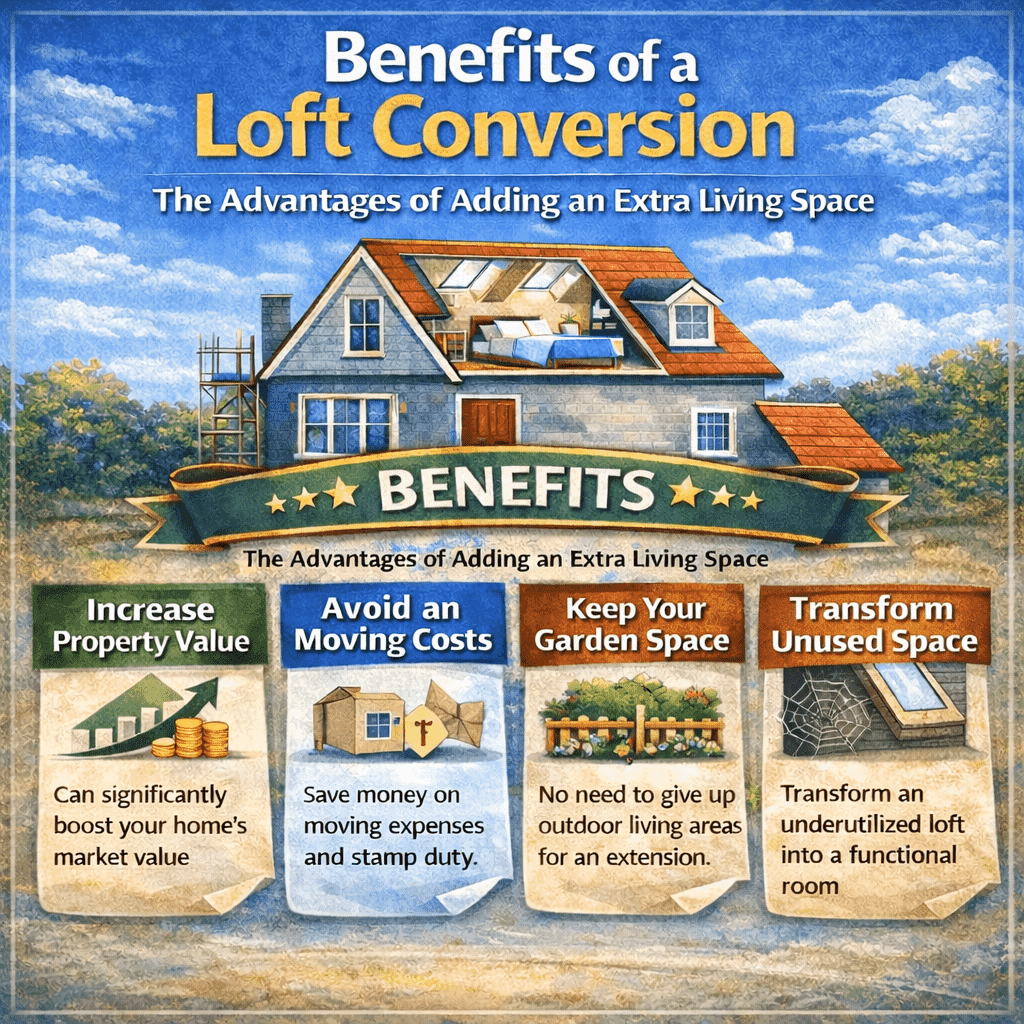
The most obvious benefit is extra living space. A new bedroom, an en-suite for teenagers, or a quiet guest room can completely change how your home feels.
Suddenly, everyone’s got room to breathe. And unlike an extension, you’re not sacrificing garden space or dealing with endless planning drama. You’re simply using what’s already there, which just makes sense.
Then there’s the money side of things. A well done loft conversion can significantly increase your property value.
Estate agents love them, buyers expect them, and homes with usable loft space tend to stand out. If you’re thinking long-term, it’s one of the smarter upgrades you can make.
I’ll be blunt: leaving a decent loft untouched in today’s market is a missed opportunity.
What really gets people excited, though, is the versatility. A loft doesn’t have to be “just another bedroom.”
It could be a home office where you can actually concentrate, a gym that saves you a monthly membership, a playroom that keeps toys out of the living room, or even a rental space bringing in extra income. What would you use the space for if you had free rein?
There’s also a quieter benefit people often overlook, energy efficiency. A proper loft conversion means modern insulation, better heat retention, and fewer draughts.
Your home becomes warmer in winter, cooler in summer, and cheaper to run. In an age of rising energy bills, that’s not something to ignore.
If you want a deeper look at how a loft conversion adds value and transforms a home, take a look at our dedicated guide: “Benefits of a Loft Conversion: Everything you need to know”
Bottom line? A loft conversion isn’t just about adding space, it’s about improving how you live in your home, every single day.
Types of Loft Conversions: An Overview
This is usually the point where people say, “Right, I want a loft conversion… but what kind?”
And fair question, because not all loft conversions are created equal. The type you choose can affect how much space you gain, how much you spend, and how disruptive the build is.
There’s no one size fits all answer here, and anyone who tells you otherwise is overselling it.
The most common option is a Velux (or rooflight) conversion. This is the simplest route, no major changes to the roof shape, just well-placed windows to bring in light.
It’s ideal if you’ve already got decent head height and want a clean, cost-effective solution. In my view, it’s often underrated. When done properly, it can look fantastic without the price tag of more complex builds.
Next up is the Dormer conversion, which you’ll see all over the UK for good reason. By extending out from the existing roof, a dormer creates extra headroom and usable floor space.
This is the go-to choice for turning a loft into a proper bedroom or office that doesn’t feel cramped. If your loft feels tight right now, a dormer can completely change the game.
For properties with a sloping roof on one side, a Hip-to-Gable conversion is worth a look. This involves straightening that slanted side to create a vertical wall, giving you more internal space.
It’s particularly popular on semi-detached homes, and when done well, it looks like it’s always been part of the house.
Then there’s the Mansard conversion, the heavyweight option. This usually means altering the entire roof structure to maximise space.
It’s more involved, more expensive, and often needs planning permission, but the payoff is huge. If you’re after maximum space and a premium finish, this is as good as it gets.
Choosing the right type comes down to your roof structure, budget, and what you actually want from the space. Are you after a simple upgrade, or do you want a full transformation? That’s the question you need to answer before anything else.
For a detailed breakdown of each option, including pros, cons, and suitability, head over to “Types of Loft Conversions Explained.” It’ll help you make a decision you won’t regret six months down the line.
Loft Conversion Costs
Let’s get straight to it, because this is the question everyone asks first.
How much does a loft conversion actually cost?
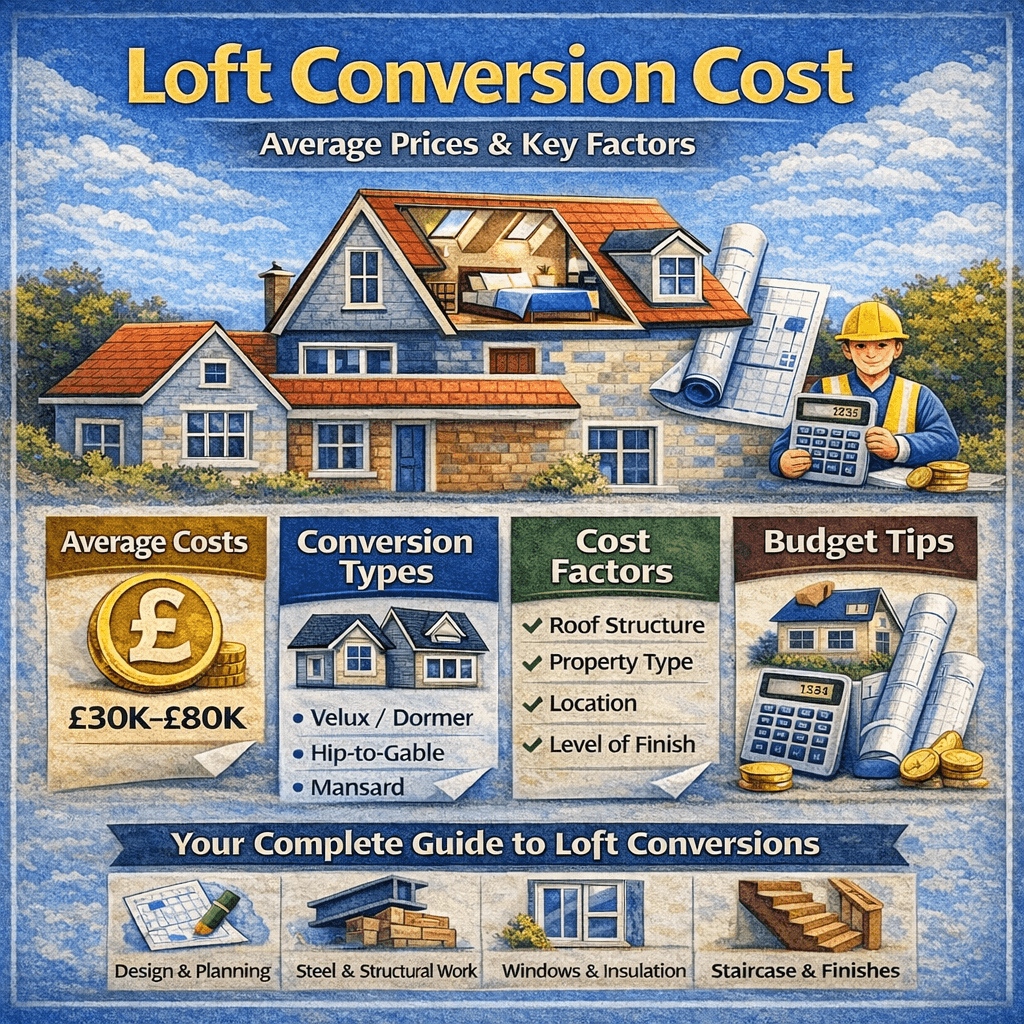
In most cases, you’re looking at prices starting from around £30,000, and that’s for a relatively straightforward conversion using the existing roof space.
Anything more complex will push that figure up, sometimes quite quickly.
If your loft already has decent head height and only needs roof windows, insulation, stairs, and a basic finish, you might stay closer to that lower end.
But as soon as structural changes come into play, such as dormers, hip to gable work, or adding a bathroom, costs rise.
And that’s not a bad thing. These are permanent changes to your home, and they need to be done properly.
What really drives the cost is complexity. Older houses often need more structural work. Tight access can add labour time. Roof shape, ceiling height, and even where the stairs need to go all affect the final price. Then there’s the finish.
A simple bedroom will cost less than a fully fitted master suite with bespoke storage and an en suite. The question is, what are you building this space for, and how long do you plan to stay in the house?
Now let’s talk value. A well executed loft conversion can significantly increase the value of your property.
In many cases, homeowners recover the cost and then some when they sell. But that only happens when the space feels like a natural extension of the home. Poor design or cheap workmanship can undo all of that potential.
One bit of honest advice. Set a realistic budget and allow a buffer. Building work almost always uncovers something unexpected. Planning for it keeps the project stress free and under control.
For a deeper look at typical costs, what influences them, and how to budget properly, take a look at Loft Conversion Costs in the UK Average Prices and Factors.
In short, starting from around £30,000, a loft conversion is not cheap, but when done right, it is one of the best long term investments you can make in your home.
The Loft Conversion Process
This is the part that puts a lot of people off. The process. Visions of endless dust, strangers in your house, and jobs dragging on for months. I get it.
But here’s the truth. A loft conversion only becomes stressful when it’s poorly planned or badly managed. When it’s done properly, it follows a clear sequence and feels far more controlled than people expect.
It starts with planning and design. This is where good projects are won or lost. Measurements are taken, the roof is assessed, and ideas are turned into something practical.
This is also the moment to be honest with yourself. What do you actually need from the space? A bedroom is very different to a home office or a full suite with a bathroom. Vague ideas lead to vague outcomes, so clarity here matters.
Next comes permissions and regulations. Some loft conversions fall under permitted development, others do not. If you are unsure what applies to your home, we break it down clearly in our guide on whether you need planning permission for a loft conversion.
Either way, building regulations still apply, and we explain exactly what that means in our guide to building regulations for loft conversions.
This is not red tape for the sake of it. These rules exist to make sure your new space is safe, structurally sound, and comfortable to live in.
If a company brushes this off or says it can be sorted later, that should set alarm bells ringing.
Once everything is approved, the build phase begins. This usually starts externally, with structural work and roof alterations, before moving inside. That approach keeps disruption to a minimum early on.
Floors are strengthened, insulation is installed, windows go in, and the stairs are fitted. This is when the loft starts to feel like a real room rather than a building site.
After the structure is complete, attention turns to electrics, plumbing, and finishes. Lighting, heating, bathrooms if you are having one, plastering, and joinery all come together.
This is the stage where quality really shows. A well finished loft should feel like it has always been part of the house, not something added on later.
Finally, there is sign off and completion. Building control inspections are carried out, certificates are issued, and the space is handed over ready to use.
At this point, you should feel confident, not relieved it is over. If the process has been managed properly, the end result is exciting rather than exhausting.
My honest view is this. A loft conversion is a serious project, but it does not need to be a painful one. The key is choosing people who have done it many times before and have a clear process they can explain in plain English.
If they cannot walk you through each step confidently, why would you trust them with your home?
For a deeper breakdown of timelines and what to expect at each stage, you can read our full guide called Loft Conversion Process From Planning to Completion. It is worth your time before you commit to anything.
Choosing the Right Loft Conversion Company
This part matters more than anything else, and I will stand by that. You can have the best idea in the world, a healthy budget, and a perfect loft on paper, but if you choose the wrong company, the whole thing can unravel very quickly. So let’s talk honestly about how to get this right.
First things first, experience counts. Loft conversions are not the same as extensions or general building work.
They involve working within tight spaces, dealing with roof structures, and keeping disruption to your home under control.
If a company cannot show you multiple loft projects they have completed, that is not bad luck, that is a warning sign.
Ask to see real examples. Ask how long the work took. Ask what went wrong and how it was handled. A good company will answer without hesitation.
You also want clarity, not charm. Be wary of anyone who tells you everything will be quick, cheap, and hassle free. Building work never works like that.
A professional company will talk you through the process in plain English, explain what is included, what is not, and where costs can change. If something sounds vague or rushed, trust your instincts. This is your home, not a sales pitch.
Communication is another big one. Who will you actually be dealing with once the work starts?
The person selling the job is often not the person managing it day to day. You should know who your point of contact is and how often you will hear from them.
Regular updates make a huge difference to how confident and in control you feel throughout the build.
Then there is paperwork. Contracts, schedules, insurance, and guarantees are not boring extras, they are essential.
If a company avoids putting things in writing or tells you not to worry about it, you absolutely should worry about it. Professional builders protect both themselves and their clients with proper documentation.
My honest advice is this. Choose the company that makes you feel informed, not impressed. The right team will educate you, challenge bad ideas, and help you make sensible decisions, even if it is not what you expected to hear.
If you want a deeper guide on what to look for and the right questions to ask, take a look at how to choose the right loft conversion company. It could save you a lot of stress later on.
Common Mistakes and Questions Homeowners Ask
This is where things usually go wrong, and it is rarely because people are careless. Most mistakes happen because homeowners do not know what they do not know.
Loft conversions look straightforward on the surface, but there are a few traps that catch people out time and time again.
We see the same issues repeat themselves across different projects, which is why we have broken them down in detail in our guide to loft conversion mistakes every homeowner should know about before committing to a build.
One of the biggest mistakes is underestimating the cost. People set a budget in their head, usually based on something they read online, and then feel blindsided when the real figures appear.
A loft conversion is a major structural project. If the numbers sound too good to be true, they almost always are. Being realistic from the start avoids disappointment later.
Another common issue is poor planning. Rushing into design decisions without thinking about how the space will actually be used leads to regret. Where will furniture go.
How will the stairs feel when you walk up them every day. Is there enough storage. These are questions worth slowing down for, because fixing them later is expensive.
Planning rules also trip people up. Many assume they can just crack on without checking. Some lofts do fall under permitted development, but not all.
Building regulations apply regardless. Skipping this step or trusting someone who says it does not matter can cause serious problems when you come to sell the house.
Then there is the question people ask all the time. Is a loft conversion worth it. In most cases, yes. If the space is designed properly and built to a good standard, it improves daily life and adds value. But it is only worth it if it is done well. Cutting corners rarely pays off.
Another popular question is whether you need an architect. The answer depends on the complexity of the project.
Simple conversions may not need one, but more involved designs often benefit from professional input. The key is choosing the right level of expertise, not the cheapest option.
If you want answers to more specific questions, including costs, permissions, and timelines, our dedicated FAQ guide goes into far more detail.
The honest truth is this. Most loft conversion problems are avoidable. Ask the right questions early, take your time with decisions, and work with people who are upfront with you. Your future self will thank you.
Conclusion and What to Do Next
So where does all of this leave you. If you have made it this far, chances are you are not just casually browsing.
You are weighing things up, imagining how that space could work for you, and asking yourself whether a loft conversion is actually the right move. And in most homes, it genuinely is.
A well planned loft conversion gives you space without forcing you to move. It adapts your home to your life rather than the other way around.
More room, better layout, increased value, and a house that finally works the way you need it to. That is not a small upgrade. That is a fundamental improvement to how you live day to day.
But here is the part people sometimes miss. The outcome depends entirely on how it is approached. Good decisions early on make everything easier later.
Clear plans, realistic budgets, and the right team turn what could be a stressful project into something genuinely rewarding. Rushing it or choosing based on price alone usually ends in frustration.
If you are still unsure, that is fine. The right next step is not committing to a build, it is having a proper conversation. Ask questions.
Talk through your ideas. Get honest feedback about what is possible in your home. A good loft conversion company will not pressure you, they will guide you. Visit Roof To Room today to explore your options and get expert advice.