Building Regulations for Loft Conversions: Everything Homeowners Need to Know
Building regulations are usually the part of a loft conversion where homeowners’ heads start to spin. We see it all the time. You might be clear on what space you want and how you plan to use it, then suddenly you are knee deep in talk about fire safety, structure and inspections and wondering why it feels so complicated.
Here is the thing though. Every loft conversion that creates a usable room has to comply with UK Building Regulations. It does not matter whether you need planning permission or not. Skip this bit or misunderstand it and you are setting yourself up for problems later, whether that is safety issues, delays or trouble when you come to sell.
In this guide, we break down what actually applies to a loft conversion, why these rules exist and how you stay on the right side of them without the stress. And if you are still exploring whether a loft conversion is right for your home, start with our complete loft conversion guide.
What Are Building Regulations?
Building Regulations are the practical rules that make sure a loft conversion is safe, sound and fit to live in. They focus on how the space is built rather than how it looks, covering things like structure, fire safety, insulation and access. Confusion usually creeps in because planning permission is often mentioned at the same time, even though the two serve very different purposes.
Planning permission deals with whether the work is allowed from a local planning point of view. Building Regulations approval is about how that work is carried out. You can need one without the other, but once a loft becomes a usable room, Building Regulations always apply. Assuming otherwise is one of the most common mistakes homeowners make.
Compliance is overseen by Local Authority Building Control or an Approved Inspector. Their inspections confirm that the work meets the relevant Approved Documents as a whole, not as isolated rules. That sign off protects safety, structural integrity, insurance cover and resale value later on.
Do Loft Conversions Need Building Regulations Approval?
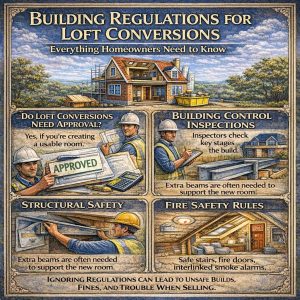
Yes. If you are creating a room you can actually use, your loft conversion needs Building Regulations approval. There is no grey area here. The moment a loft becomes a bedroom, office or any space intended for day to day use, it is classed as habitable and the regulations apply in full.
Habitable space simply means somewhere designed for regular occupation. That triggers requirements around structure, fire safety, insulation and access because people will be spending real time in the space. The only real exception is a loft used purely for storage, and even then it is easy to cross the line unintentionally by strengthening floors or changing access.
Ignoring Building Regulations tends to catch up with people. Enforcement action, missing completion certificates and unsafe layouts all cause problems later, particularly when selling.
Key Building Regulations for Loft Conversions
When people hear Building Regulations, they often assume it is one rule covering everything. In reality, it is a series of connected requirements that manage different risks. Building Control looks at them together because overlooking one area usually creates problems elsewhere.
Structural Safety Part A
Most lofts were never designed to support the weight of a habitable room. Existing floor joists are often too light, which is why additional structural support is needed. Steel beams are commonly used to transfer loads down to suitable load bearing walls. This is where structural engineer calculations come in. They remove guesswork and ensure the structure performs properly long term, preventing issues like cracking ceilings or springy floors.
Fire Safety and Escape Routes Part B
Adding a new storey changes how people escape in a fire. Fire doors are often required to protect the escape route, staircases usually need to form a protected enclosure, and smoke alarms must be interlinked so warnings are shared throughout the house. Escape windows can work in some layouts but not all. In taller homes, sprinklers may be needed to meet the standard. These measures exist because escape time matters.
Staircases and Access Part K
Stairs need to be safe and comfortable for everyday use. Regulations set limits for head height, pitch and width, along with proper handrails and guarding. Ladders rarely meet these requirements and are not accepted for habitable rooms. If the space is meant to be used daily, the access must reflect that.
Insulation and Energy Efficiency Part L
Poor insulation leads to uncomfortable rooms and higher energy bills. Minimum insulation levels are set to control heat loss and manage condensation. When done properly, this improves thermal performance and protects the structure over time.
Sound Insulation Part E
Noise transfer becomes more noticeable once a loft is in use. Regulations require measures to reduce sound travelling between floors, which is particularly important in terraced and semi detached homes. Fixing this later is difficult once finishes are in place.
Ventilation Part F
Lofts are vulnerable to condensation without proper ventilation. Background ventilation and mechanical extraction work together to manage moisture. Bathrooms and ensuites must remove humid air at source to prevent damp and mould.
Electrical and Plumbing Safety Parts P and G
Electrical work must be certified to reduce fire risk and ensure the system can handle the added demand. Plumbing work must also meet standards for water supply and drainage so pressure and hygiene are maintained.
Building Control Inspections Explained
Building Control inspections confirm that the work meets the regulations at key stages. Inspectors are not there to redesign your loft, but to check that critical elements are correct before they are covered up.
Structural work is usually inspected early so floors and steels are approved before being hidden. Insulation checks confirm heat loss and condensation risks have been addressed. Fire safety elements such as doors, alarms and escape routes are reviewed before completion. The final inspection brings everything together and leads to the completion certificate.
You can use Local Authority Building Control or an Approved Inspector. Both serve the same purpose, though their processes differ. When inspections are planned into the build, they rarely cause delays and often prevent costly mistakes later.
Building Regulations vs Planning Permission
This is where confusion often starts. Planning permission and Building Regulations are linked in conversation but deal with separate issues. Planning permission controls whether the work is allowed. Building Regulations control how it is built and whether it is safe to live in.
Some loft conversions need both. Larger dormers, roof alterations or homes in conservation areas often trigger planning permission alongside Building Regulations. Many lofts fall under permitted development, meaning planning permission is not required. What never changes is the need for Building Regulations approval once habitable space is created.
Assuming that no planning permission means no rules is a common and costly misunderstanding.
What Happens If Your Loft Conversion Doesn’t Comply?
When a loft conversion does not meet Building Regulations, the issues often surface later. Building Control can require remedial work through enforcement action, even years after completion. That usually means opening up finished areas to prove compliance.
Retrospective approval through a regularisation certificate is sometimes possible, but it often involves inspections and corrective work. This process is almost always more expensive and stressful than getting it right first time.
Problems also arise when selling. Missing completion certificates raise red flags for buyers, solicitors and lenders, which can delay or derail a sale entirely.
How to Ensure Your Loft Conversion Meets Regulations
Compliance starts with using people who understand loft conversions specifically. These projects rely on correct structural design, fire safety planning and coordination with Building Control from the outset.
Structural engineers should be involved early so the design works before construction begins. Keeping Building Control engaged throughout the build helps catch issues while they are still easy to fix.
Once complete, keep all certificates and sign off documents safe. They provide proof the work was done properly and remove friction when the property changes hands.
Conclusion
Building Regulations are not there to stop loft conversions. They exist to protect the people living in the space and the value of the home itself. When they are followed properly, the result is a loft that feels solid, safe and comfortable rather than compromised.
Compliance means the structure performs as it should, fire safety has been properly considered and future buyers have confidence in the work. From our point of view, getting this right is not about paperwork. It is about ending up with a safer home, stronger resale value and genuine peace of mind.
If you are thinking about a loft conversion and want clear, honest advice from people who do this every day, you can find out more about how we work at Roof to Room.